Jessie C.A. Traill
Research toward catalogue raisonne – free download below
Jessie Constance Alicia Traill was born in Brighton, Melbourne on the 29th of July 1881. She was the youngest of four surviving daughters of George Hamilton Traill and his second wife Jessie Frances Montague Neilley.
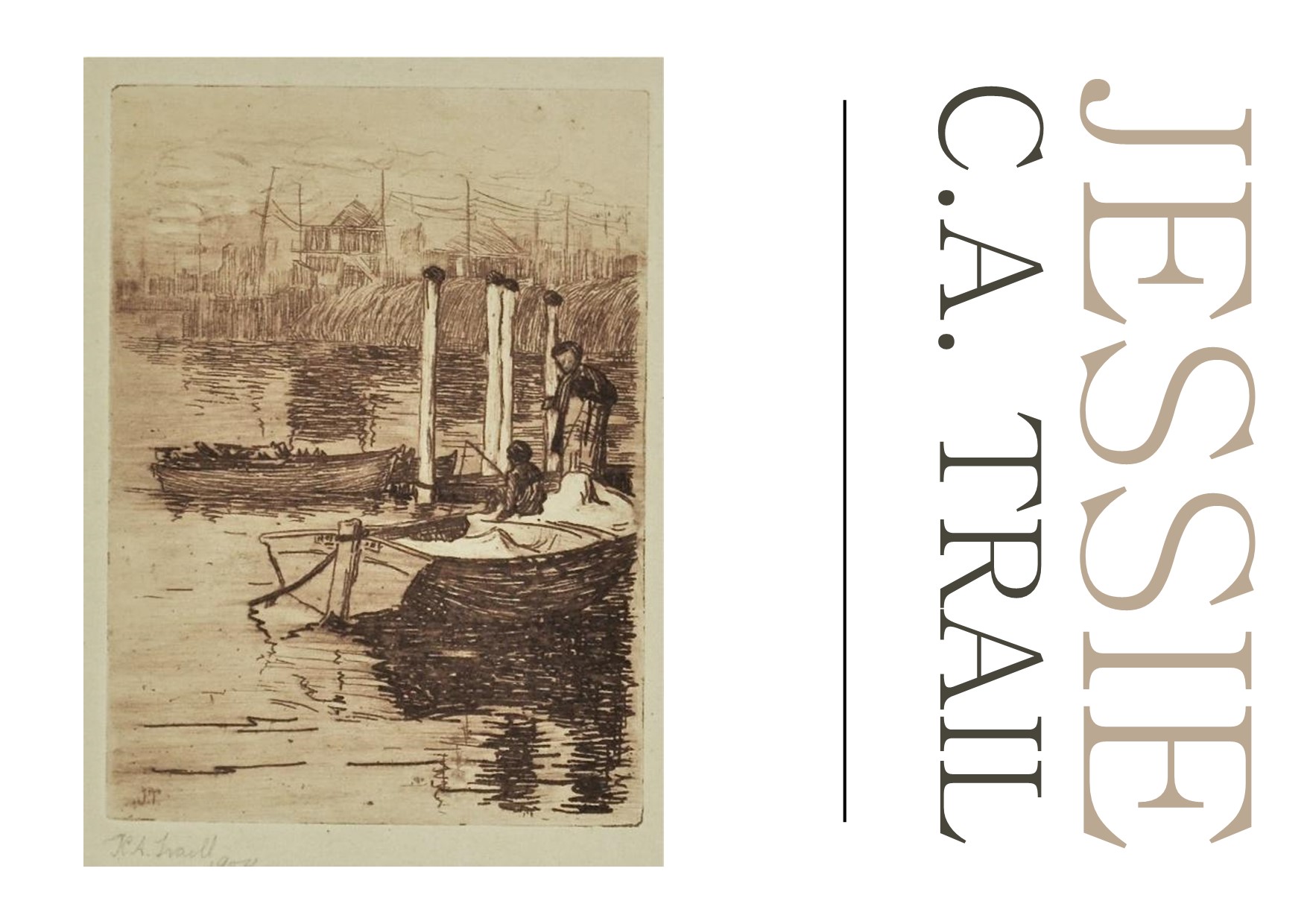
Jessie enrolled to the National Gallery Art School in 1901 with friends Norah Gurdon and Janet Cumbrae Stewart, where she studied under the renowned Australian painters Fredrick McCubbin and Lindsay Bernard Hall. She thrived in this environment and proved herself from the start, being the only member of her friends to be recognised at the school’s annual exhibition in the first years, receiving 1st prize for drawing hands and feet. In 1902 she received 1st prize for drawing the anatomical figure, and 2nd for drawing from the antique. During her studies, Jessie developed an interest in the process of etching and in 1903, signed up to John Mather’s Austral Art School, marking the beginning of a life-long practice in printmaking.
In 1907, Jessie departed Australia with her father and sister for Europe where she planned to study the work of the Great Masters in Italy, though on the 7th of April 1907, George died suddenly in Rome, leaving his daughters grief stricken and alone. The sisters returned to England to be with family and before long, Jessie enrolled at the London School of Art where she furthered her skill in etching under Frank Brangwyn. Jessie also spent time in Paris where she enrolled briefly to the Academie Colarossi.
Before Jessie returned home in April of 1909 her etchings were accepted for exhibition at the Royal Academy and Paris Salon. At the outbreak of war, Jessie returned to England where she to enlist with the British Red Cross as a VAD, serving in France for the duration of the war.
During her life, Jessie would prove an avid and adventurous traveller and enthusiastic motorist who explored the remote pockets of Australia with her sketchbooks. She travelled to England and Europe at least 10 times during her life and toured remote parts of Central and Northern Australia, producing pictures of places and structures that she knew would evoke a sense of wonder in the Australian public. She died in 1967, leaving behind a clever and historically important body of work. For a more detailed biography, please download the free catalogue below.
